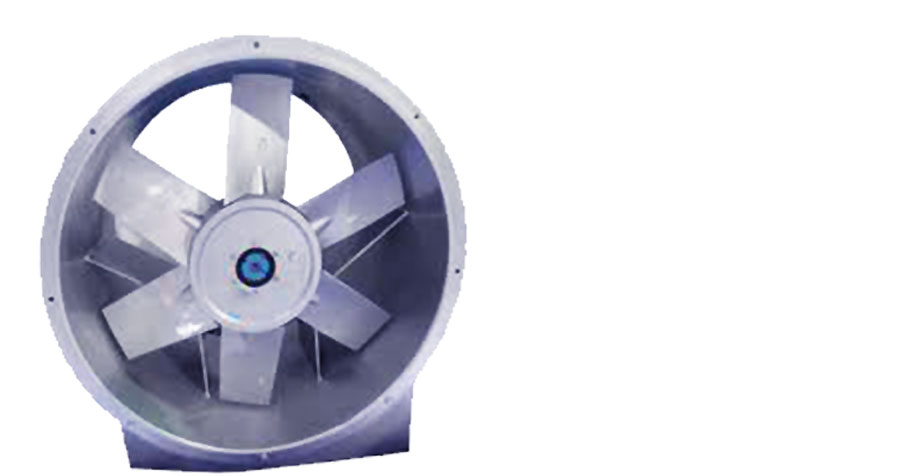
Axial Flow Fan
Axial flow fans, as the name indicate draws the air and blows forward, which moves in the axis of the fan. There would be no centrifugal effect on the airflow generated. Guides or stator vanes serve to smoothen/ straighten the airflow and improve efficiency. In general, an axial-flow fan is suitable for a larger flow rate with a relatively small pressure gain and a centrifugal fan for comparatively smaller flow rate and a large pressure rise. They are used to supply fresh air, to suck air from return air trenches, to suck air from rotary filters, to exhaust air out etc. Depending on the purpose and the quantity of air handled the size and materials of the fan are decided.
The blade force necessarily has an additional component in the tangential direction, providing the reaction to the driving torque: this sets the air spinning about the axis independently of its forward motion. The air delivering capacity of axial flow fans ranges from 100 to 500000 cubic feet per minute (3 to 14000 cubic meters per minute). Axial fans are compact and, relatively easily, incorporated in the system. It can be placed at low or high level in the plant room, in false ceilings, and in either vertical or horizontal ducts. The fan's configuration makes it suitable for installations in which the intake and discharge connections are opposite to one another.